The digestive system is the key to great healthUnderstanding your gutThe digestive system is the key to great health. And one of the easiest ways to keep an eye on it is through something most of us never speak about: poop. Why your poop matters As strange as it sounds, your stool can tell us a lot about what’s happening inside your body. Your digestive system is linked to: – your immune system – your mood and brain (your gut is often called your “second brain”) – inflammation levels – detoxification (including how your body clears hormones like oestrogen) – and of course, how well you’re absorbing nutrients In functional medicine there’s a saying: “When a case feels complex, start with the gut.” Your gut helps with at least 6 of the 7 key functions of health: assimilating nutrients, biotransformation and elimination, defence and repair, transport and communication. So yes – your poop is worth paying attention to. A quick note on “poop can save a life” You may have heard of faecal microbiota transplants (FMT) – where healthy gut bacteria from a donor stool are transplanted into someone with a severe gut infection such as *C. difficile*. These procedures are done in specialised medical settings and can be very helpful for carefully selected patients. They’re not a DIY option – but they do remind us how powerful the gut ecosystem can be.
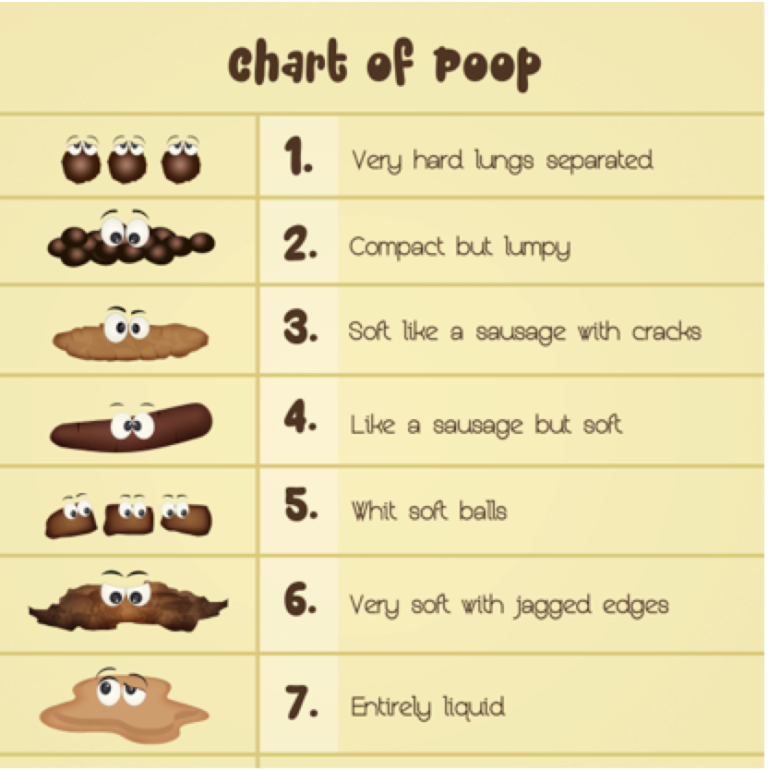
If you’ve not been in the habit of checking your poop before you flush, it’s time you changed your game. Remember a sneak peek before you flush is one step closer to knowing your health and gut state better. Healthy and normal poop is what you want to maintain as much as you can. (You will need to leave out the pretty blue or green dye which is still popular, even though it doesn’t do anything useful for the environment…) In order for you to be convinced that your poop is normal and healthy, the first step is to understand what normal poop looks like. To help you visualize and understand what different types of stools mean, if they are healthy or not, herewith below is the Bristol stool scale. The Bristol stool scale is a chart that was designed to classify poop into different categories and also to check your gut function.
|
|
The Normal Poop Type 4 is the ideal normal poop you want to have. It features the below: So, to summarise a normal poop looks like a brown banana, which is why a “brown banana” is good for you… Once your poop deviates from any of the characteristics of the normal poop, you might need to visit the doctor or look at your lifestyle so that you amend any glitch that could be causing abnormal stool. The Abnormal Poop [Red flag zone] Type 1-2 and type 6 – 7 as per the Bristol chart are key indicators that something could really be wrong with your digestive system. Some of the situations that are often associated with abnormal poop include the following: Pooping too often Not pooping often enough Painful or strenuous pooping episodes Blood in stool Bleeding while passing stool Very hard, dry poop that is difficult to pass Watery poop Colored poop, green, yellow, white, black
This is the zone you want to avoid as much as you can. In order for you to avoid having abnormal poop, you need to know some of the causes so that you phase them out: Stress Dehydration Lack of dietary fiber Medical ailments Certain medicines Not going when you feel the urge The color, smell of your poop can indicate or show different types of ailments associated with your health as well as if it’s a floater or a sinker. Once you notice, red, dark, or pale green stool you should immediately treat that as a red flag and consider seeing a doctor or taking measures to try and bring it back to normality. How you achieve healthy and normal poop is entirely up to you. Remember, once you have a healthy poop, it also gives you peace of mind, revitalizes your energy, and makes your visits to the toilet less stressful. Here are some tips on how you can increase your chances of having a healthy and normal stool : |
- Increase your fiber intake
- Avoid processed foods and alcohol
- Use the miracle that is water
- Don’t hold it in. once you feel the urge to, just go for it
- Use a deep squat position when pooping
- Use a Magnesium supplementation – but it needs to be specifically magnesium citrate to produce soft stool.
- Exercise regularly
- Decrease reliance on laxatives. If you have been using laxatives for years, then slowly move onto natural remedies and then slowly see if you can reduce those as well.
- Reduce stress as much as you can. Funny thing if you are in a state of stress, that is your brain thinks a lion is behind you then there is no time to ‘do your business’. If you have not seen the video on how stress impacts your body here is the link: Click here
- Increase your intake of naturally fermented foods
With so much said about poop, my advice to you, look, listen, smell before you flush. If you have a change in stools accompanied by abdominal pain, don’t treat it at home.
Click below and we will get you sorted one needle at a time.
Regards
Dr Debbie
Common questions about poop and gut health
Is it normal to poop only once a week?
Some people naturally go less often, but once a week is usually on the slow side. If stools are hard, painful to pass, or your pattern has changed, it’s worth speaking to a practitioner rather than just living with it.
What if my stool is green?
Bright green stool can simply reflect what you’ve eaten (for example lots of green veggies) or food moving quickly through the gut. If it keeps happening, especially with pain, diarrhoea or other symptoms, get it checked.
When should I worry about blood in my stool?
Any blood you see in the toilet, on the stool or on the toilet paper is a reason to speak to a doctor. It doesn’t always mean something serious, but it should never be ignored.
Can stress really change my bowel habits?
Yes. When your nervous system is in “fight or flight”, digestion slows down or speeds up. Many people notice they get constipated or have diarrhoea when stressed. Supporting your stress response is often part of supporting your gut.